
Designing Ecommerce Item Data for GA4 Hotel Booking Funnels
# Designing Ecommerce Item Data for GA4 Hotel Booking Funnels
GA4 ecommerce events become much more useful when the item data is consistent throughout the customer journey.
For a hotel booking application, the same customer may interact with a hotel at several stages:
Hotel Result
    ↓
Hotel View
    ↓
Room Availability
    ↓
Selection
    ↓
Checkout
    ↓
Purchase
The analytics model should preserve meaningful identifiers and context across these stages.
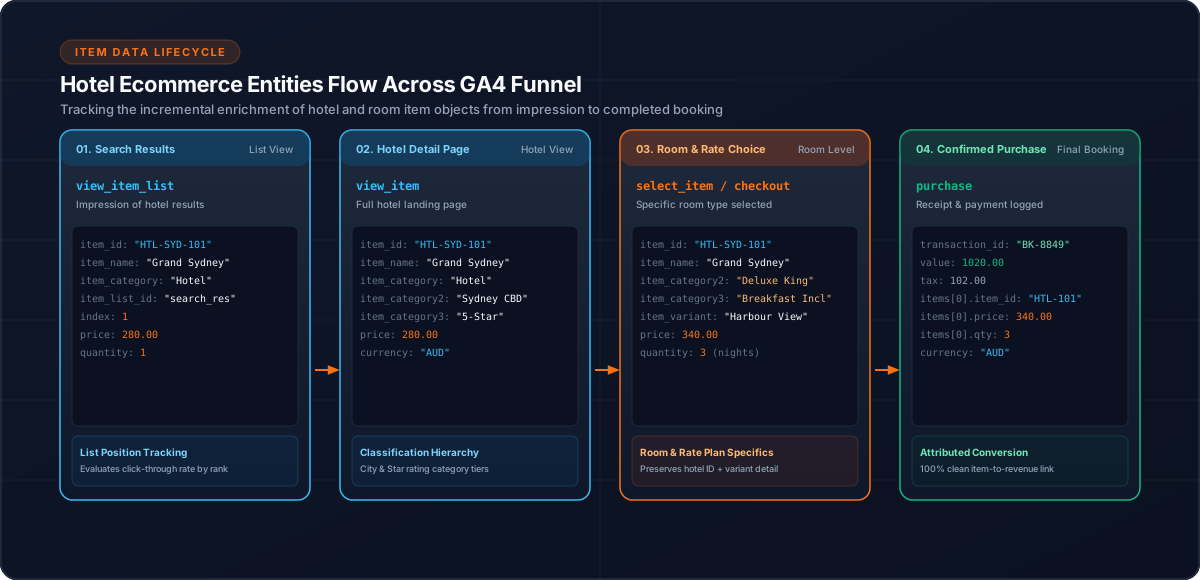
1. Separate Business Entities From Analytics Items
The application's hotel model does not have to be identical to the GA4 ecommerce item.
Instead:
Application hotel model
        ↓
AnalyticsService
        ↓
GA4 ecommerce item
This gives the analytics layer control over the external schema.
2. Establish Stable Identifiers
A hotel should have a consistent identifier.
For example:
{
  item_id: hotelId,
  item_name: hotelName
}
The same hotel identity should remain consistent between:
view_item_list
view_item
select_item
purchase
where the event semantics require the item.
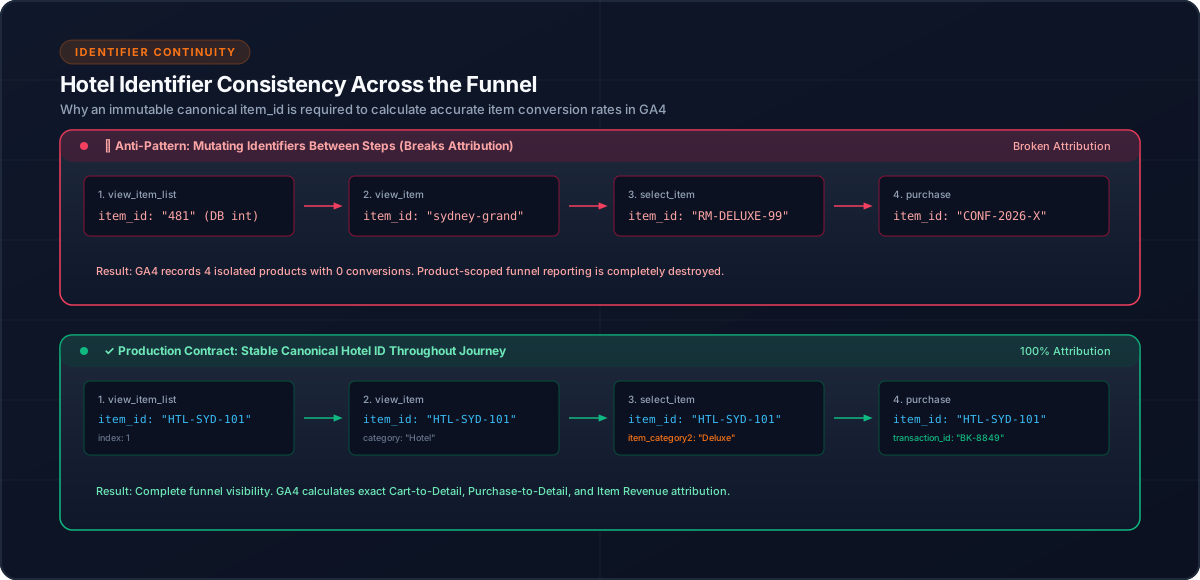
3. Hotel Result Lists
A result list can represent multiple hotels:
{
  event: 'view_item_list',
  ecommerce: {
    items: hotels.map(hotel => ({
      item_id: hotel.id,
      item_name: hotel.name
    }))
  }
}
The exact item fields should follow the application's analytics contract.
4. Hotel Detail
A hotel detail view can use:
{
  event: 'view_item',
  ecommerce: {
    items: [
      {
        item_id: hotelId,
        item_name: hotelName
      }
    ]
  }
}
The important point is that the item identity remains stable.
5. Selection
When a customer selects an option:
select_itemcan identify the selected item.
This creates a bridge between browsing and booking intent.
6. Room-Level Information
Hotel booking applications often have a second level of detail: rooms and rates.
A room selection can require additional context such as:
hotel
room
rate
occupancy
dates
The analytics payload should include only the information required for the event's purpose.
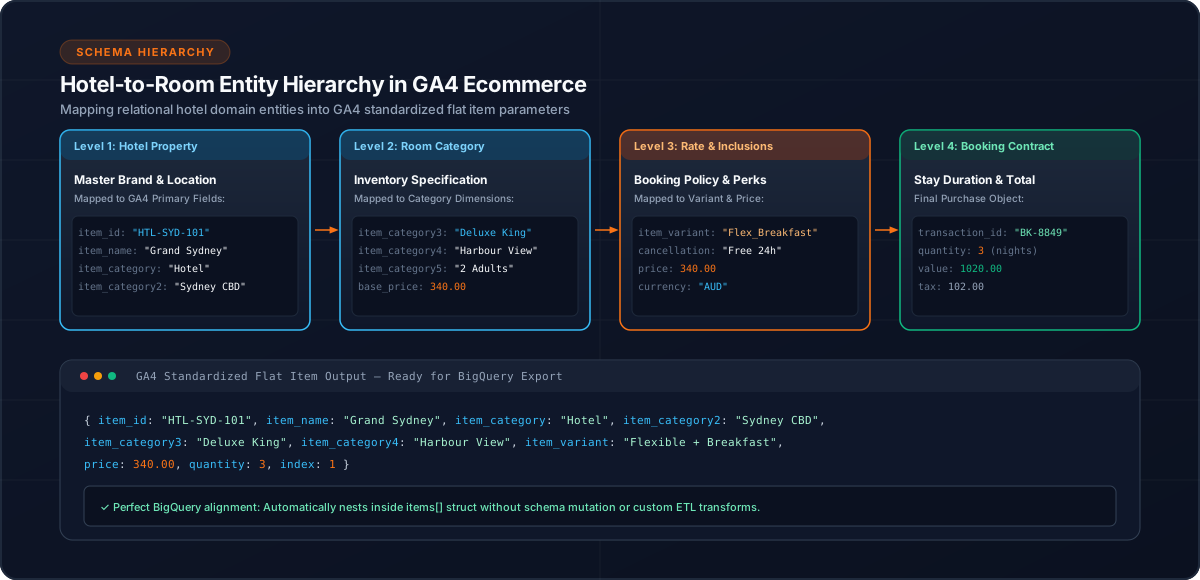
7. Purchase Item Data
The purchase event should provide the transaction identity and relevant ecommerce items.
{
  event: 'purchase',
  ecommerce: {
    transaction_id: bookingId,
    items
  }
}
A stable transaction ID is particularly important for purchase reliability.
8. Clear Ecommerce State
Before pushing a new ecommerce payload:
window.dataLayer.push({
  ecommerce: null
});
Then send the current event.
This prevents the analytics layer from unintentionally carrying previous ecommerce state.
9. Do Not Send the Entire Application Object
Avoid:
items: [hotelObject]when hotelObject contains large internal structures.
Prefer an explicit mapping:
items: [{
  item_id: hotel.id,
  item_name: hotel.name
}]
This keeps the analytics contract predictable.
10. Maintain Consistency
If the same concept is represented differently in different events, analysis becomes harder.
Avoid:
hotelId
hotel_id
propertyId
property_id
for the same identifier without a deliberate reason.
Define the mapping once.
11. Testing Item Data
Test the complete path:
Result list
 ↓
Hotel view
 ↓
Selection
 ↓
Checkout
 ↓
Purchase
Verify that:
12. Common Mistakes
13. Conclusion
Good GA4 ecommerce tracking starts with a good item model.
For hotel booking applications, stable hotel identifiers, deliberate room/rate representation and explicit mapping from application models to analytics items create a more reliable ecommerce dataset.
Related Content
Need enterprise architecture consulting?
Explore our real-world case studies detailing production migrations, performance scaling, and high-throughput gateways.