
Klaviyo vs GA4: What Should Each Platform Track?
# Klaviyo vs GA4: What Should Each Platform Track?
When an Angular hotel booking application uses both GA4 and Klaviyo, one of the biggest design questions is:
Which events belong in which platform?
The answer is not to send every event identically to both systems.
GA4 and Klaviyo serve different purposes.
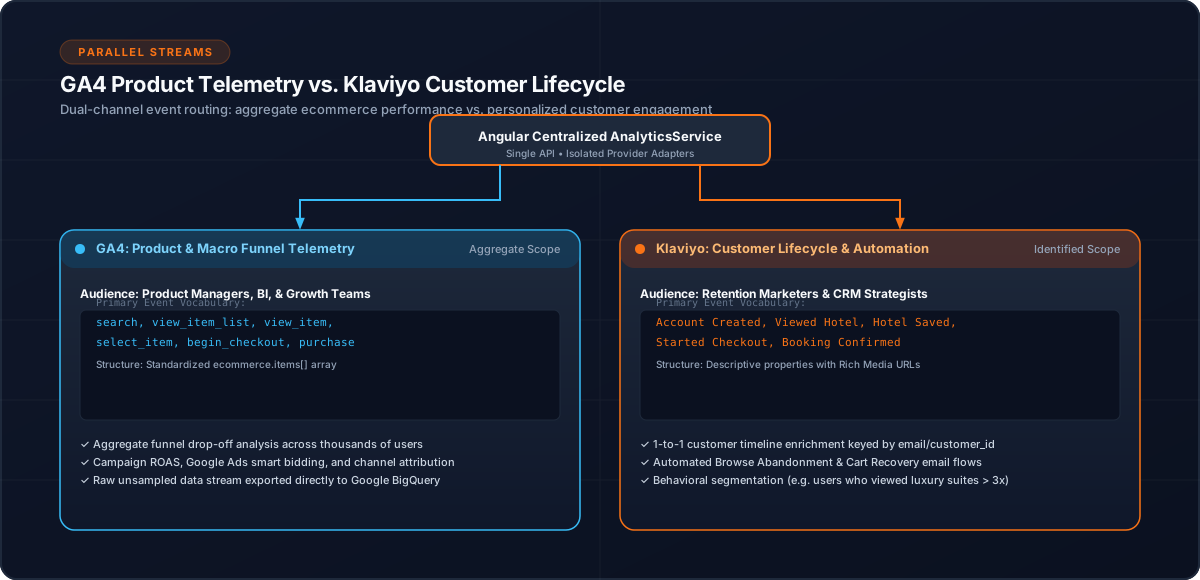
1. Different Jobs, Different Event Models
A simplified distinction is:
GA4
 ↓
Analytics / ecommerce / funnel analysis

Klaviyo
 ↓
Customer behaviour / lifecycle / marketing automation
Both can receive behaviour information, but their primary use cases differ.
2. GA4 Is Strong for Funnel and Ecommerce Analysis
For a hotel booking platform, GA4 events can represent:
Search
 ↓
Hotel Results
 ↓
Hotel View
 ↓
Rooms
 ↓
Checkout
 ↓
Payment
 ↓
Purchase
The focus is understanding the broader customer journey and ecommerce performance.
3. Klaviyo Is Strong for Customer Behaviour
Klaviyo events can represent:
Account Created
 ↓
Searched Destination
 ↓
Viewed Hotel
 ↓
Hotel Saved
 ↓
Checkout Started
 ↓
Booking Confirmed
The focus is customer lifecycle and behaviour associated with identifiable customers.
4. Some Events Can Belong to Both
There can be overlap.
For example:
Hotel Viewcan be useful to GA4 for product/hotel analysis and useful to Klaviyo for customer behaviour.
The payload and implementation should still be designed separately for each provider.
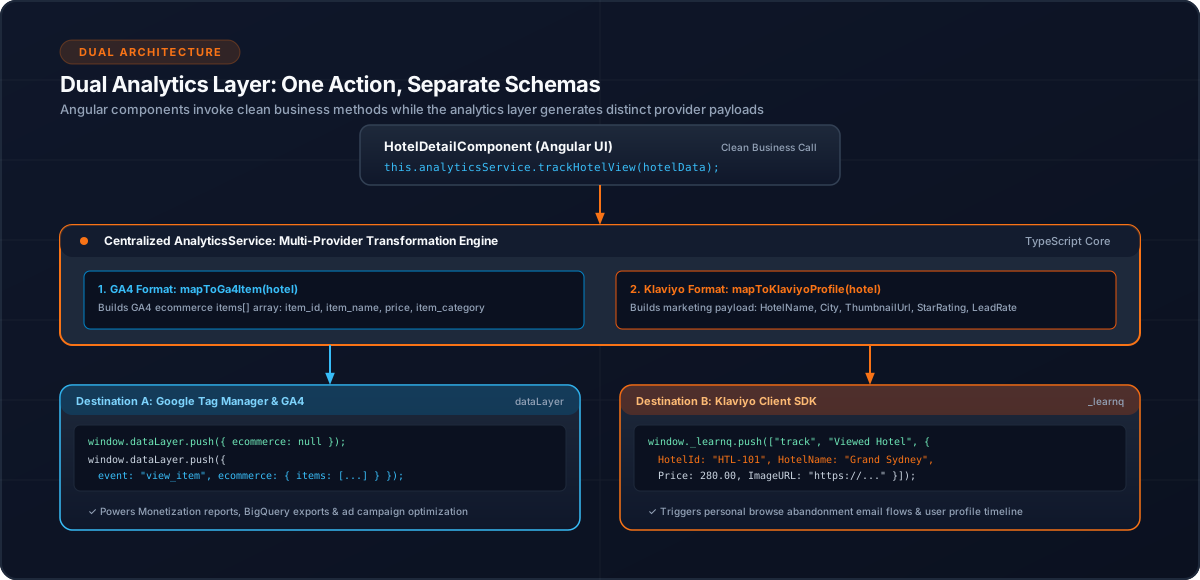
5. Avoid Creating One Giant Universal Payload
A common mistake is creating one object and sending it unchanged everywhere.
Instead:
Business action
      ↓
AnalyticsService
      |
      +----> GA4 representation
      |
      +----> Klaviyo representation
Each provider gets the fields appropriate for its purpose.
6. Example: Search
GA4 may focus on search and funnel analysis.
Klaviyo may focus on customer behaviour and destination interest.
The same business action can therefore produce different provider payloads.
7. Example: Purchase
GA4 purchase tracking is ecommerce-oriented:
transaction_id
items
purchase context
Klaviyo booking confirmation is customer-lifecycle oriented.
The two events should not be assumed to have identical schemas.
8. Example: Saved Hotel
A saved hotel may be especially valuable as a customer behaviour event.
Viewed Hotel
     ↓
Hotel Saved
That behaviour can be useful to Klaviyo even if it is not a primary ecommerce metric in GA4.
9. Centralize Both Providers
The application can use:
Angular
   ↓
AnalyticsService
   |
   +----> GTM / GA4
   |
   +----> Klaviyo
This keeps provider differences inside one application-level boundary.
10. Practical Decision Table
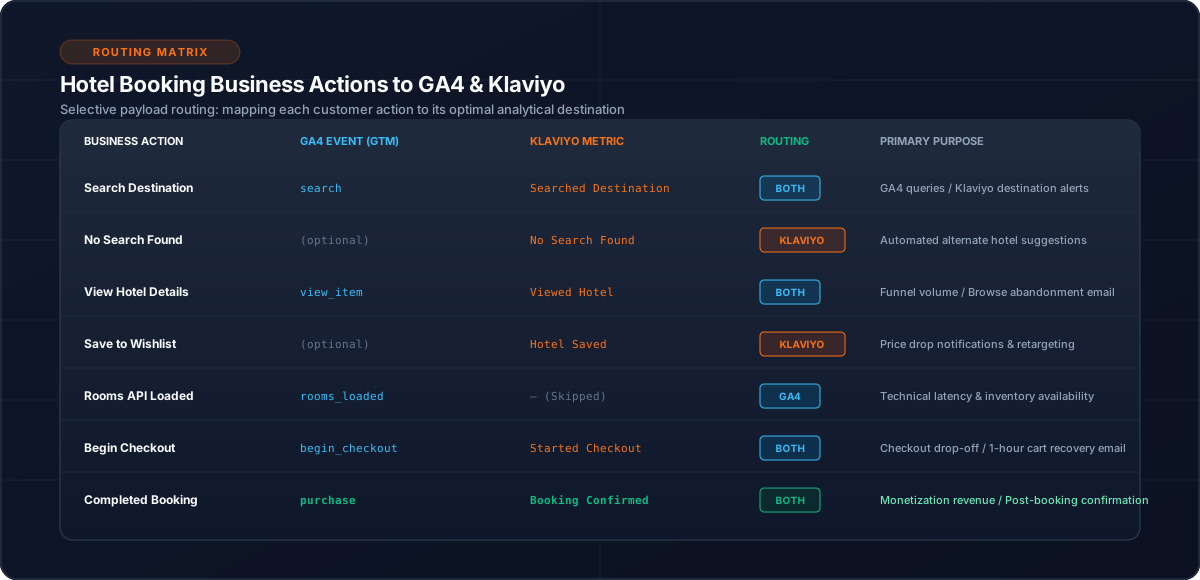
| Business action | GA4 | Klaviyo |
|---|---|---|
| Account Created | Useful | Useful |
| Search | Useful | Useful |
| No Search Found | Optional | Useful |
| Hotel View | Useful | Useful |
| Hotel Saved | Optional | Useful |
| Rooms Loaded | Useful | Usually less important |
| Selection | Useful | Optional |
| Checkout Started | Useful | Useful |
| Payment Started | Useful | Optional |
| Purchase / Booking Confirmed | Essential | Useful |
The exact implementation should follow the application's business and analytics requirements.
11. Avoid Duplicate Responsibilities
Do not make both platforms responsible for exactly the same reporting question.
Instead define:
GA4 → product/ecommerce/funnel analytics
Klaviyo → customer behaviour/lifecycle
with intentional overlap where it provides value.
12. Conclusion
GA4 and Klaviyo can work together without becoming redundant.
The key is to begin with business events and then create provider-specific representations.
A centralized Angular analytics service provides the architectural boundary needed to keep both systems consistent while allowing each platform to serve its intended purpose.
Related Content
Need enterprise architecture consulting?
Explore our real-world case studies detailing production migrations, performance scaling, and high-throughput gateways.